

Evangelical-Jewish Relations Conference

Evangelical Jewish Relations:
Politics, Policy, and Theology
|
|
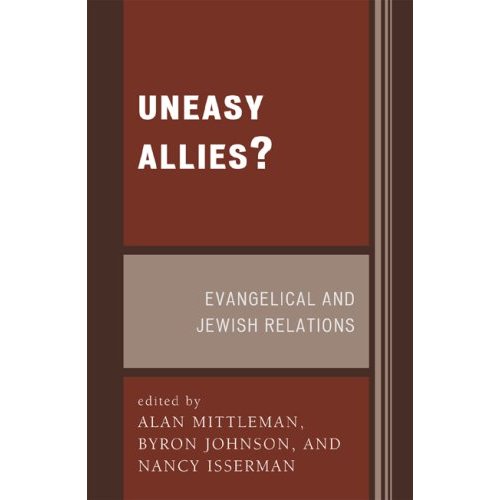 Uneasy Allies? |
|
| Evangelical Jewish Relations: Politics, Policy and Theology Conference Program |
Conference Co-Sponsors:
The Feinstein Center for American Jewish History,Temple University; The Louis Finkelstein Institute, The Jewish Theological Seminary; and Baylor Institute for Studies of Religion.
Both Evangelicals and Jews are important stakeholders in contemporary American culture, politics and civic life. Yet these two groups have been largely estranged from one another. Evangelicals, when defined in denominational terms, have historically been concentrated in parts of the country where Jewish population is thin. Lacking direct acquaintance with Jews, some Evangelicals view them primarily through the lens of preconceived religious and cultural ideas. Jews tend as well to stereotype Evangelicals. A recent survey indicates that Jews rate Evangelicals least favorable of all Protestant groups. Jews tend not to distinguish contemporary Evangelicals from Fundamentalists, suspecting both of religious intolerance, conversionary zeal, and illiberal political leanings. The real and complex history of post-war evangelicalism is simply unknown in the Jewish community. If contemporary sociologists of religion are correct, however, Evangelicals are likely to resemble Jews of the same generation in many significant ways. The cultural distance between them may not be as large as the stereotypes suggest.
A striking change, moreover, has recently occurred in the long-static relationship between Jews and Evangelicals. The so-called second “Intifada” has significantly tarnished Israel’s reputation among some of American Jewry’s traditional allies. In the past, American Jews have been wary of accepting the support of evangelical and fundamentalist Christian allies, fearing that their support comes at too high a price. Over the past four years, however, Jewish leaders in the mainstream Jewish organizations have been much more open and eager to accept evangelical and fundamentalist support. We are, therefore, in the midst of a sea change in the Evangelical-Jewish relationship, at least at the level of elites. A careful study of the evolving relationship of the two communities is the focus of this conference.
For a program of the 2005 Conference:Uneasy Allies? Evangelical-Jewish Relations Today