Astrophysics and Space Science Theory CASPER Early Universe Cosmology and Strings Gravity, Cosmology and Astroparticle Physics Hypervelocity Impacts and Dusty Plasmas Lab Space Science Lab
Baylor > CASPER > Outreach > NSF RET Program

NSF RET Program

Research
- Theoretical
- Experimental
- Experimental Astronomy
- Undergraduate Research

Education
- Graduate Studies
- Undergraduate Studies
- Graduate Courses
- Undergraduate Courses
- Texas Space Grant Consortium

Outreach
- CASPER Summers
- NSF Fellows Evaluation Form
- 2009 NSF REU and RET Fellows' Final Projects
- NSF REU Program
- NSF RET Program
- Internships
- High School Scholars
- Physics Circus
- Partners in Education
- 2009 REU/RET Application Has Passed
- CASPER Space Place
- NASA Astronaut Sandra Magnus:

News
- CASPER News
- Seminars
- Events
- Commercials
- CPS Plasma Page

About
- Labs
- Personnel
- Open Positions
- Assistant Director of Research, CASPER
- Research Faculty Position in Complex (Dusty) Plasmas
- Graduate Research Assistantships
- Graduate Research Assistantships (Spanish)
- FAQ
- CASPER Partners
- Contact Us


CASPER's Summer Research Experiences for Teachers Program (sponsored by the National Science Foundation, Baylor University, the Physics Department and CASPER) offers elementary school, middle school and high school teachers an opportunity for active research participation with Baylor University faculty in the Center for Astrophysics, Space Physics & Engineering Research. The primary purpose of the Summer RET Program is to allow teachers to develop new curriculum while interacting in a working research environment. This is part of a nation-wide effort to enable public school teachers the opportunity to infuse cutting edge science and technology into the classroom. The eight week program will begin around the first of June and end around the middle of August. (The starting and ending dates are flexible and may be adjusted to fit ISD schedules.) RET Fellows will be paid up to two months of their current annualized salary for the eight week period.

Potential Research Areas

NSF RET Fellows are allowed to tailor their summer research activities from a number of Center efforts. They meet with NSF REU Fellows on a weekly basis immersing them in current, cutting edge physics research topics. They can also choose to meet with CASPER's outreach team allowing them to integrate with CASPER's Physics Circus, Women in Physics or Inservice outreach efforts. During the summer, they can tailor their CASPER experience choosing from a variety of areas such as developing curriculum modules designed to take hands-on physics activities into the classroom, receiving in-service training in a wide variety of areas including grants procurement, distance learning technology and web based instructional methods or conducting research with a CASPER faculty member. CASPER's connections with the Department of Education, the National Science Foundation, NASA and local area foundations provide RET Fellows a wealth of material to take back into the classroom. Additional opportunities for RET Fellows to continue to interact with CASPER (either in person or via distance learning capability) during the fall and spring semesters are also available.

For those RET Fellows that so desire, they can become involved in any of the research areas available to the NSF REU Fellows. Current theoretical research areas within the Center include astrophysics, cosmology, hypervelocity impact physics, protoplanetary development studies, quantum gravity, shock physics, superstrings and complex (dusty) plasma physics. Current experimental research areas in the Center include hypervelocity impact physics, in-situ sensor design studies, shock physics and complex plasma physics. Current research areas within the Department of Physics include theoretical surface physics and particle physics and experimental surface physics.

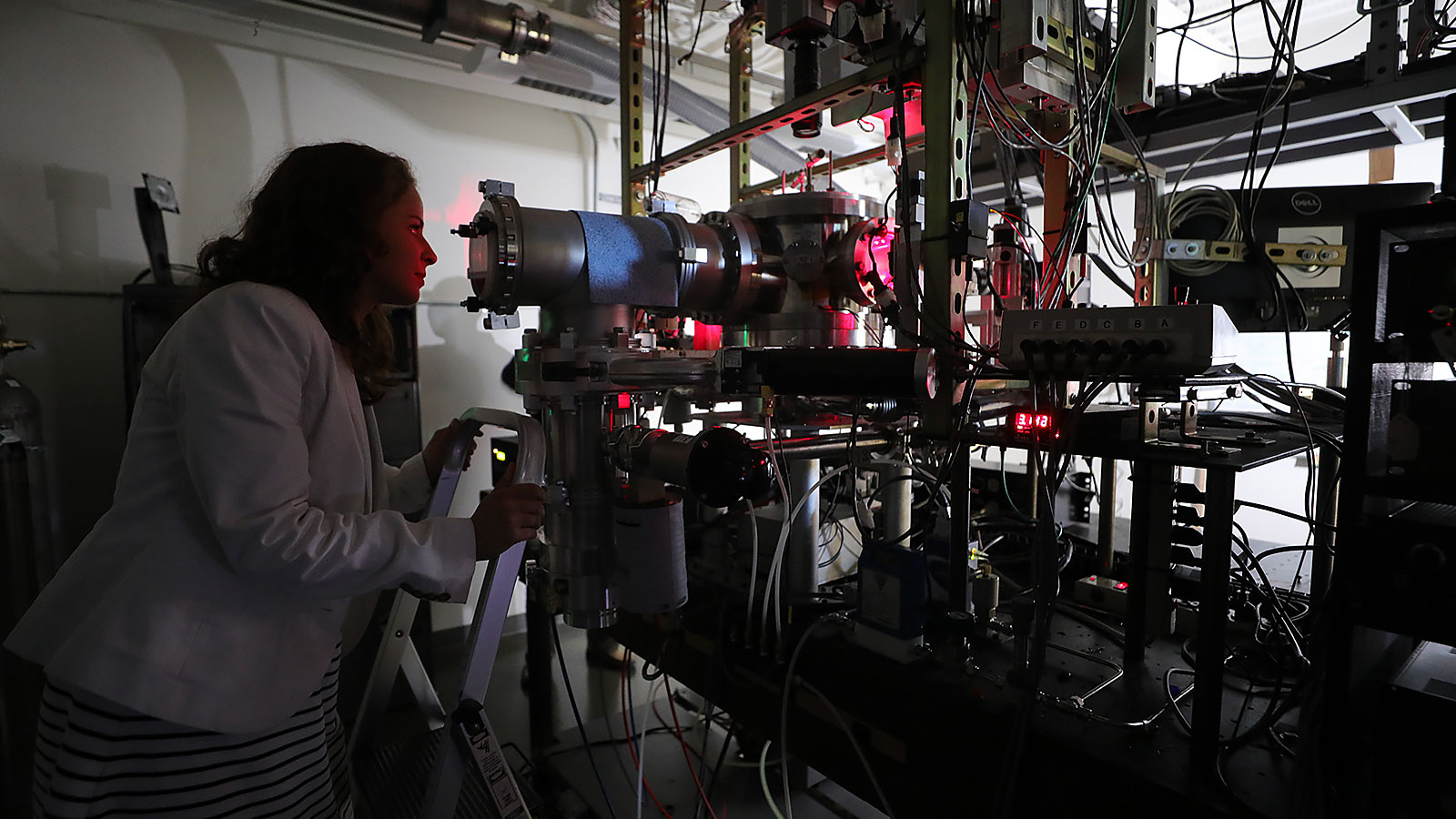
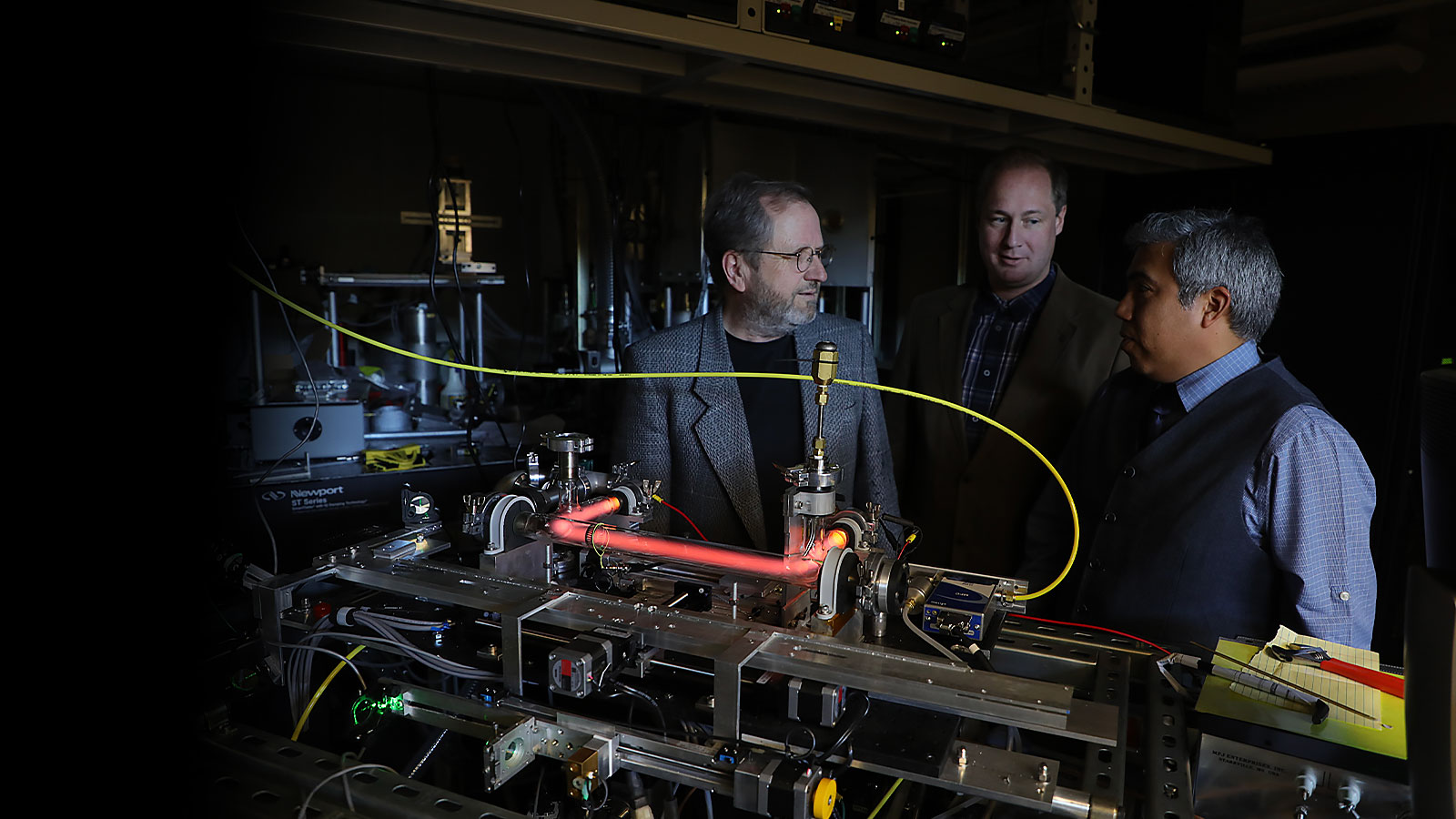
Fellows interested in theoretical research can study a variety of projects within the Center such as the computer modeling of protoplanetary and planetary ring systems or ordered lattice formation and electromagnetic wave scattering within complex plasmas. Within the Department, they can pursue numerical simulations of QCD on a discrete space-time lattice with Monte Carlo statistical methods or the study of metal surfaces with and without adsorbed layers of atoms with the Solid State Group. In the experimental areas, RET Fellows can choose to work in one of two active labs. In the Laboratory for Surface Analysis and Modification (LSAM) they can learn to characterize surface atomic and electronic structure(s) using highly surface sensitive diagnostic tools such as angle-resolved ultraviolet photoemission spectroscopy (ARUPS), low energy electron diffraction (LEED), angle-resolved X-ray photoemission spectroscopy (ARXPS) or electron energy loss spectroscopy (EELS). In the Hypervel ocity Impacts & Dusty Plasmas Lab (HIDPL) RET Fellows can study shock physics employing either a light gas or electrostatic accelerator or conduct complex plasma research in one of two GEC rf reference cells. In the Space Science Lab (SSL) Fellows can learn about flight system instrumentation or diagnostic and calibration methods using a light gas accelerator or an electrostatic accelerator. Each of the above projects will be directed by a faculty member within CASPER or the physics department. Brief descriptions of the research areas listed above can be found on the CASPER Professors' Research Interests page and the Physics Professors' Research Interests page.


Eligibility and Selection Criteria

Current teachers in math or any of the physical sciences (or education majors interested in pursuing a career in STEM) are eligible. Applicants will be considered for appointment without regard to race, creed, color, sex, national origin, age, handicap status or any other non-merit factor. Appointment selection is competitive on a national scale and will be based upon the following criteria:

  1. career objectives and scientific interest,
  2. match of applicant interest with available projects within the Center or the Department and
  3. letters of recommendation.

Applications are currently being accepted for the summer of 2010 dependent upon receipt of NSF funding. Interested applicants must complete their application before March 30, 2010 to insure they receive full consideration.

To begin the application process, please fill out the RET Application Form online. Recommendation letters must be sent via snail-mail to the address given below. Letters of references must be on school letterhead and delivered in a sealed envelope.

Awardees will be notified by email of their acceptance into the program. Awardees must acknowledge receipt of the email within five days of the email notification. For final confirmation of appointment, successful applicants must sign a letter of acceptance (or rejection) of the offer to participate within one (1) week of the email acknowledgement.

This program is funded by the National Science Foundation, the Department of Education and Baylor University.

Dr. Truell W. Hyde, Director
CASPER
One Bear Place #97310
Waco, Texas 76798-7310

Phone: (254) 710-3763 Fax: (254) 710-7309
Truell_Hyde@baylor.edu

Related Links

RET Application Form

CASPER Professors' Research Interests

Physics Professors' Research Interests

Fellows Evaluation Form

Fellows Questionnaire Form

Archived Photos


Click Image to Enlarge


Click Image to Enlarge


Click Image to Enlarge


Click Image to Enlarge

22

Copyright © Baylor® University. All rights reserved. Trademark/DMCA information. Privacy statement.
Center for Astrophysics, Space Physics & Engineering Research
Baylor University
One Bear Place #97310
Waco, TX 76798-7310

Main Offices - 254.710.3763 (Voice) - 254.710.7309 (FAX)
HIDPL/SSL - 254.867.3167 (Voice) 254.867.DUST (FAX)
http://www.baylor.edu/CASPER/