Students interested in applying for a CASPER Fellowship should begin the application process
by reading the descriptions of the active research areas within CASPER which are listed below.
A brief description of each research area along with selected papers and related links are
supplied to provide applicants with relevant background material. A more comprehensive
description with a list of selected CASPER papers and background reading material is
included as a single pdf document below.
Selected CASPER papers and background reading material.
CASPER - HIDPL/SSL Summaries
Low Velocity Impact Studies/Dust Detector Design - Truell Hyde, Lorin Matthews, Jorge Carmona, Mike Cook, Jimmy Schmoke
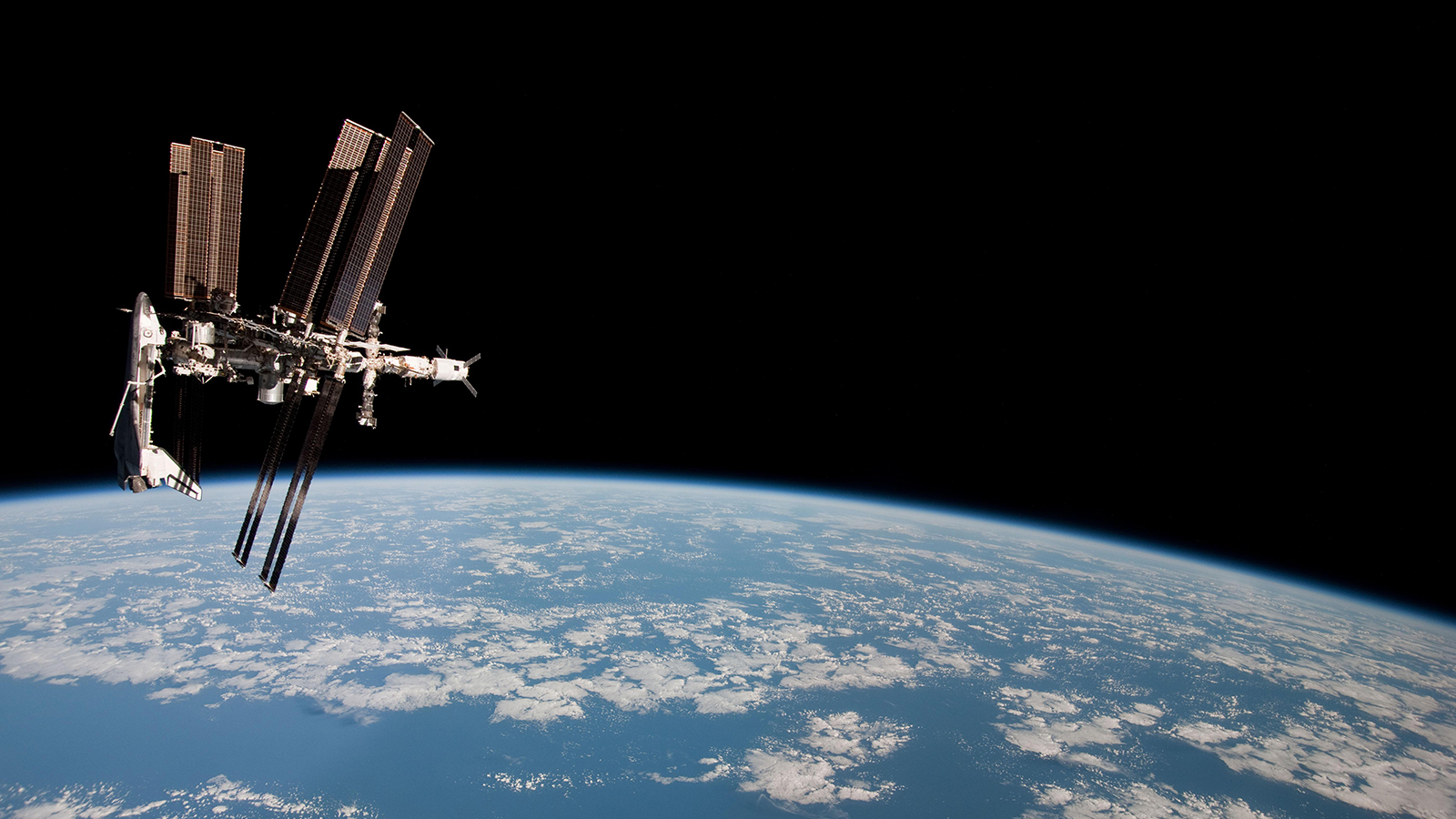
Spacecraft in near-earth orbit and on deeper space missions are subject to damage from impacts
with interplanetary dust and orbital debris. Low impact studies are designed to characterize the
dust encountered in space and test materials for damage. Several experiments using two single-stage
gas guns are underway, including:
- Corroboration of the sensitivity map for the stainless steel plate with piezoelectric lead
zirconate titanate (PZT) crystals attached. The voltage and resonant frequency of the output
from the sensor must be measured. A full understanding of the sensitivity map requires
understanding not only the electrical response from the PZTs but also the acoustics of
the plate, which must be measured as well.
-
Completion of experiments on damage assessment of aluminum and stainless steel plates,
using different projectile materials and sizes.
-
Analysis of laser fan data, which measures the projectile's velocity in flight,
to determine particle dimensions by the shape and amplitude of the signal.
-
Small Satellite Studies/Dust Detector Design - Truell Hyde, Rene Laufer, Lorin Matthews, Jorge Carmona, Mike Cook, Jimmy Schmoke
-
Small Satellites provide opportunities for research in near-earth orbit and as
components of deeper space missions. As mentioned above, CASPER has specific
interest in the detection of interplanetary dust and orbital debris. The Space
Science Lab within CASPER currently has several active flight missions on which
they will be providing the science instrument. The first of these is scheduled
for launch in August of 2012 and will include a new dust detector design with
heritage from flight instruments that have flown on missions to Halley's comet
and Saturn. Development of these dust detector experiments is currently underway.
As such, REU Fellows can participate in (among others):
-
Research and design of the detector system.
-
Design and development and testing of the electronics.
-
Design and development of the mechanical system.
-
Design and development of flight software.
-
Design and development of the spacecraft interface.
The above will be completed in conjunction with CASPER partners at the
University of Texas at Austin
and Virginia Tech
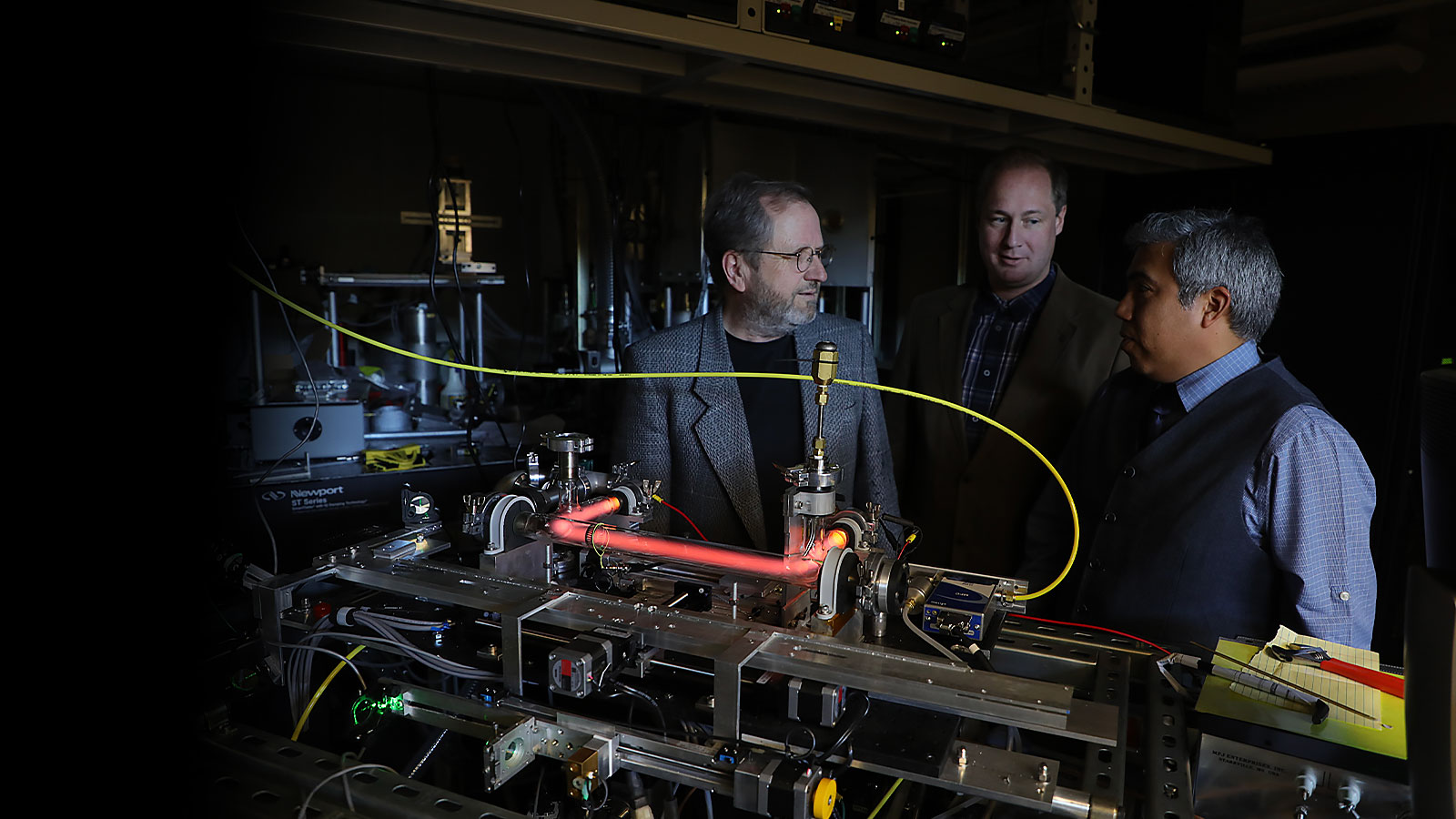
Dust Crystals in an RF Reference Cell - Truell Hyde, Lorin Matthews, Jie Kong, Ke Qiao, Bernie Smith, Jorge Carmona, Mike Cook, Jimmy Schmoke
Dust particles immersed within a plasma environment acquire an electric charge. If the ratio of the
inter-particle potential energy to the average kinetic energy is high enough the particles can form a
"liquid" structure with short-range ordering, a crystalline structure with longer range ordering or a
mixture of the two. A variety of experiments within complex plasmas investigating nano- and meso-scale
physics will be on-going during the coming summer. Additionally, the S100 nano-manipulator brought on-line
in June 2005, provides unparalleled perturbative capabilities for the lab. Complete lab diagnostics and
theoretical simulation capabilities as well as full-time technical support providing machining capability
and electronics R&D are also available to Fellows working within the HIDPL. A list of current projects
available along with background reading material, is appended to this document.
CASPER – Experimental Astronomy Summaries
Experimental Astronomy - Dr. Dwight Russell and Mr. Dick Campbell
Using the CTAS(Central Texas Astronomical Society) telescope at the Clifton site, in collaboration with
the UT astronomy department, we will study luminosity curves for white dwarf stars. The data will be taken
and used to study periodic variations in the intensities of these stars. The expected periodicity is in the
range of 1s to 1000s. This time scale allows for usable data to be taken in the relatively short period of
time of one night to a few nights. The CTAS telescope is a state of the art computer controlled facility.
The collaboration with UT-Austin will put this research into a larger context of white dwarf physics
helping to guide this work toward publishable results. As part of this project, the student(s) will be involved in:
-
star selection
-
operation of the CTAS telescope via the internet interface
-
the recording and analysis of the data. Raw Data will be in the form of CCD images
that will need to be converted to light curves.
-
Meyer Observatory
-
Central Texas Astronomical Society
CASPER – ASSTG Summaries
Numerical Simulation of Plasma Crystals - Truell Hyde, Lorin Matthews, Ke Qiao, Jie Kong
Dust particles immersed within a plasma environment, such as those found in nanomanufacturing or in
protostellar clouds, planetary rings or cometary environments, acquire an electric charge. If the
ratio of the inter-particle potential energy to the average kinetic energy is high enough the particles
will form either a "liquid" structure with short-range ordering or a crystalline structure with long
range ordering. Properties of these dust crystals have been studied within CASPER both numerically and
experimentally. The following numerical simulations utilize the Box_Tree code.
-
Structure and phase transitions in 2D and 3D plasma crystals.
-
Wave properties of a bilayer system (particle populations with different sizes).
-
Simulation of wake force caused by ion drag and study of its effect.
-
Simulation of the thermophoretic force and study of its effect.
-
The results of numerical simulations, such as the dispersion property of the out of plane
transverse DLW mode recently discovered theoretically, can also be verified experimentally
in the HIDPL A list of current projects available within the CASPER theory group, along with
background reading material, is appended to this document.
Kuiper Belt Studies - Truell Hyde, Ray Nazzario
Recent observations show that binary Kuiper Belt objects exist contrary to most theoretical expectations.
(These are the same objects that recently resulted in the 'demotion' of Pluto.) Although their creation
presents problems in current models, the inclusion of a third body (ex. one of the outer planets or a
forming protoplanet) often provides several of the necessary conditions for their formation. The presence
of such a perturbing body can also provide clearing of the primordial Kuiper Belt while at the same time
producing quasi-stable, longer-lived binary Kuiper belt objects. Numerical investigations involving a fifth
order Runge-Kutta algorithm are employed to examine the situation described. Up to thousands of Kuiper
belt sized objects are simulated to look for the formation of binaries (along with structure of the resulting
belt) in both solar systems and protoplanetary situations. The interparticle gravitational interactions can
create one of several effects; scattering into the Oort cloud, collisions with nearby growing protoplanets,
formation of binary pairs, or creation of a single Kuiper belt object. Additionally, the initial location
of the progenitors of the Kuiper belt objects may also have a significant effect on binary formation with
objects near resonances tending not to form binary objects. A list of current projects available within the
CASPER theory group, along with background reading material, is appended to this document.
Numerical Simulation of Preplanetary Dust Aggregation - Truell Hyde, Lorin Matthews
Recent data from the Hubble telescope show that planetary formation from the cloud of gas and dust orbiting
a new protostar is a much more efficient process than first believed and may occur on a time scale of less
than 10 million years. Initially uncharged grains in space and laboratory plasma environments become charged
due to currents driven by potential differences in the dusty plasma. Certain macroscopic effects such as
coagulation of smaller grains into larger fluffy aggregates are then affected by the grain charge. The charge
distribution on the aggregate structure itself appears to play a role in determining the coagulation rate for
the dust population. As particles collide, a numerical code can be used to determine the effect of the dipole
and higher multipole charge distributions on the openness of the resultant fractal aggregate and the coagulation
rates of the particles. A list of current projects available within the CASPER theory group, along with background
reading material, is appended to this document.
Gravitoelectrodynamics in Saturn's Rings - Truell Hyde, Lorin Matthews
Saturn's magnetic field exerts a significant perturbative force on charged micron- and submicron-sized
grains in its ring system. This force has been shown to cause the formation of "spokes" in Saturn's B ring
and may play a large role in the formation of the evolving clumps, kinks, braids and waves observed in
Saturn's F Ring. These effects can be modeled numerically using the Box_Tree code and can be used to predict
or explain new features that currently being seen by the Cassini probe in orbit around Saturn. A list of
current projects available within the CASPER theory group, along with background reading material,
is appended to this document.
CASPER - EUCOS Projects
Theoretical Early Universe Cosmology and Superstrings - Gerald Cleaver
Over the last two decades, the theorized number of (meta)-stable string vacua (models) has jumped from only
a few trillion to anywhere from 10^100 to 10^1000. The collection of these string models has become known
as the string landscape. No longer do string phenomenologists concentrate on examining the phenomenology and
features of individual models, but on the common phenomenology of models within local neighborhoods on the
string landscape. Thus, gradually different pieces of the landscape will become understood and eventually
the pieces may fit together.
At Baylor, properties of a class of models known as free fermionic heterotic models are under study, with
primary attention given to a special collection of them known as NAHE-based (named after the originators
of this type of model-Nanopoulos, Antoniadis, Hagelin, and Ellis) free fermionic heterotic string models.
REU students proficient in C or C++ are invited to assist in the development of associated software.
REU students will be working with Ph.D. student Doug Moore to parallelize the primary systematic string model
construction and analysis programs or with Ph.D. student Jared Greenwald on a program that systematically analyzes
complete sets of (D- and F-)flat directions and the resulting ranges of phenomenology, especially those of hidden
sector (dark) matter.